
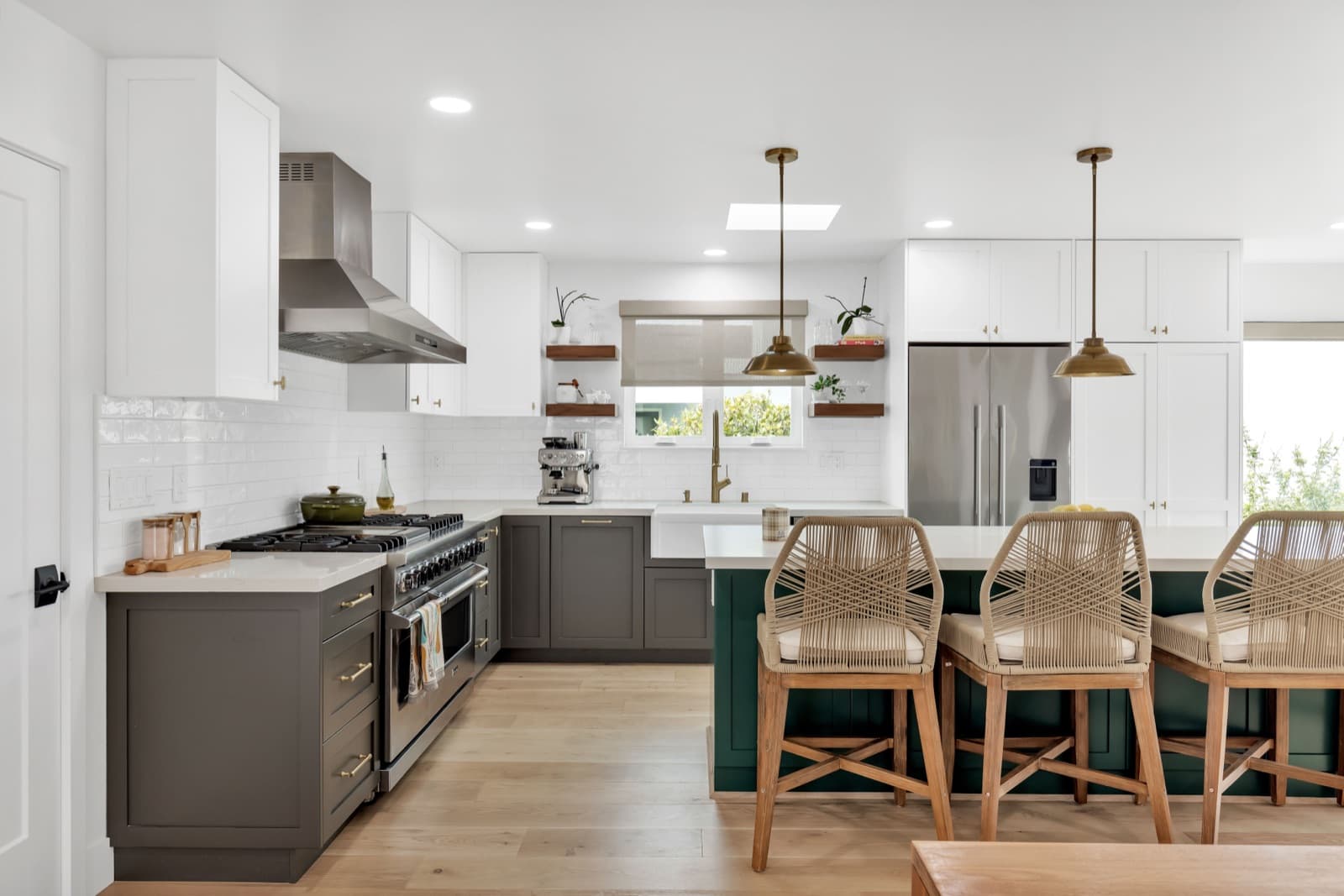
Kitchen Remodeling
Your kitchen is where life happens — morning coffee, family dinners, holiday gatherings. We design and build kitchens that are as functional as they are beautiful, with premium materials and layouts tailored to how you actually live.
Have questions about your kitchen remodeling project? Talk to Us
How We Approach Your Kitchen
We start with how you actually use your kitchen — how you cook, how your family gathers, what frustrates you about the current layout. Then we design around your real life, not a catalog photo. Every countertop height, cabinet placement, and lighting choice is made with your daily routine in mind.
A kitchen remodel touches every trade: cabinetry, countertops, plumbing, electrical, flooring, lighting, backsplash, and appliance installation. We coordinate all of them under one schedule with one point of contact, so you’re never chasing down subcontractors or managing conflicting timelines.
From opening up a cramped galley layout to a complete gut renovation with custom islands and premium finishes, we guide you through material selections, design options, and the permitting process. Most Bay Area kitchen remodels take 6–12 weeks depending on scope — we’ll give you a realistic timeline upfront.
What Shapes the Scope of a Kitchen Remodel
Kitchen projects generally fall into a handful of tiers. A cosmetic refresh keeps the layout and focuses on paint, refacing or painting existing cabinets, hardware swaps, a new countertop, and updated lighting. A mid-range remodel brings in new semi-custom cabinets, quartz counters, tile backsplash, mid-tier appliances, and updated flooring. A full gut renovation adds custom cabinetry, natural stone, professional-grade appliances, and often structural changes. Each tier answers a different question about how far you want to go.
Cabinets are usually the single largest line item and the decision that shapes every other decision. Stock cabinets from a big-box supplier are the most affordable option but limit your sizing and door-style choices. Semi-custom cabinets give you far more flexibility in dimensions and finishes at a moderate step up. Fully custom cabinetry is built to exact wall dimensions with tailored interior storage — it makes a dramatic difference in how the finished kitchen looks and functions, at a dramatic step up in investment.
Countertop material is the next big decision. Laminate is inexpensive but dates a kitchen quickly. Quartz is the Bay Area’s most popular choice — durable, non-porous, and consistent in appearance. Natural stone like marble, quartzite, or exotic granite is a premium option that rewards homeowners who want character, but it requires sealing and more careful daily use. Appliance grade matters too — builder-grade packages sit at one end, professional suites with 48-inch ranges, panel-ready refrigerators, and vent hoods at the other.
Layout changes are where budgets often stretch. Moving a sink, relocating gas lines for a range, or adding a range hood that vents to the exterior all require coordinating plumbing, electrical, and sometimes structural work. Opening a load-bearing wall to connect the kitchen to a living area adds a structural engineer’s stamp, a beam, and additional permit review. Permitting in Bay Area cities adds weeks of pre-construction review and should be planned into the overall timeline.
Common Mistakes Homeowners Make
The most common mistake is designing for looks instead of workflow. A Pinterest-perfect island that forces you to walk around it to reach the refrigerator becomes a daily annoyance. We always map the cook’s triangle — refrigerator, sink, range — and check drawer and door swings against real movement patterns before we approve a layout.
Underestimating storage is the second big miss. Homeowners often cut upper cabinets for aesthetics, then realize a year later that pantry items and small appliances have nowhere to live. A well-designed kitchen plans for tall pantry pullouts, deep drawers under the cooktop, and a dedicated spot for things like the coffee setup and the microwave before a single cabinet is ordered.
Choosing materials without seeing them in your actual lighting is another frequent issue. Showroom lighting is very different from the west-facing afternoon sun that floods many Bay Area kitchens, and a quartz sample that looks warm under halogen can read cold and blue at home. Always take large samples home and look at them in morning, afternoon, and evening light before you commit.
Finally, many homeowners sign with the lowest bidder without understanding what’s excluded. A low estimate that skips permits, appliance installation, disposal fees, and finish carpentry becomes a significantly higher project by the end. We itemize every inclusion and exclusion up front so the number you see is the number you pay.
How Long a Kitchen Remodel Takes
Design and selections typically take 3–6 weeks. This is when you finalize the layout, pick cabinets, choose countertops, select appliances, and approve lighting and plumbing fixtures. Rushing this phase is the single biggest cause of mid-project delays, because cabinet lead times can run 6–12 weeks on their own.
Permitting varies by city. San Jose and Oakland often turn around straightforward kitchen permits in 2–4 weeks. San Francisco and Berkeley tend to run 6–10 weeks, especially if there’s any structural work. We submit permits in parallel with the selections phase so construction can start as soon as materials arrive.
On-site construction usually runs 6–10 weeks for a standard remodel and 10–16 weeks for a full gut or an expanded footprint. Demolition is typically a few days. Rough plumbing, electrical, and framing take 1–2 weeks. Drywall, flooring, and cabinet installation fill another 2–3 weeks. Countertop templating happens after cabinets are set and adds a 1–2 week fabrication window. Backsplash, final plumbing, appliance install, and punch list close out the project.
What to Look for in a Kitchen Contractor
Verify the California State License Board (CSLB) number is active and carries a B General Building classification. Ask for proof of current general liability insurance and workers’ comp coverage for every crew member who will be on site. These are not optional — an uninsured injury on your property can become your problem fast.
Ask to see three kitchens the contractor has completed in the last year, and specifically ask to see one where something went wrong. Any real remodeler has had a countertop arrive cracked, a cabinet order come in short, or an inspection fail. How they handled it tells you far more than their photo gallery does.
Finally, look at how the contract is written. A real contract lists every allowance (the dollar figure assumed for items you haven’t picked yet), a clear payment schedule tied to milestones rather than calendar dates, and a defined change-order process. Vague contracts are where disputes live.
Why Bay Area Homeowners Choose Genesis
We’ve completed kitchen remodels across San Francisco, the Peninsula, the South Bay, and the East Bay. That geographic range matters because every jurisdiction has its own permit quirks, and a contractor who only works in one city will learn yours on your dime. We already know the local plan-check reviewers, the inspection scheduling windows, and the submittal requirements across the region.
Every Genesis kitchen gets a dedicated project manager on site and a clear point of contact from kickoff to closeout. You won’t be chasing subcontractors, coordinating deliveries, or wondering who’s in your house today.
We stand behind the materials we install and the work we do. If something isn’t right after we leave, we come back and make it right — a relationship that starts with clear expectations up front.
What Our Clients Say
“We interviewed five contractors before choosing Genesis for our kitchen remodel. Best decision we made. They walked us through every material choice,...”
Rachel P.
Kitchen Remodel
Ready to start your kitchen remodeling remodel?
Schedule a free consultation and let's bring your vision to life.
Get Your Free Estimate(800) 950-3984